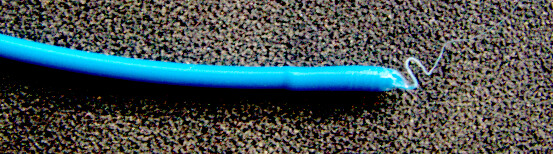
PLA was supposed to be easy to print. But then I bought a new roll.
Time to clog is about 0.3s now. It clogs literally before bed finishes heating up. Best case it clogs 10min into the print. HELP
Background: Bowden setup. The nozzle is 0.4mm. The hot end is V6 with the rectangular heating element.
I tried printing at anything between 185 °C and 230°C, same outcome.
When I pull out the clogged filament, it looks like on the picture.
Sometimes I can just use more force and it comes through, most of the time I need to snip off the thicker part (last 1cm). Then it slides in easy. I am able to begin the print if I keep pushing manually all the time until the actual print begins, but it usually clogs later anyway.
The thick part, when I hold the piece against the hot end, seems to be in the nozzle itself. Does it mean the nozzle doesn’t get hot enough or something?
Any hints?
Could be any number of reasons why.
Wet filament would be the first thing to try and just because the role is new doesn’t mean anything. If the filament is wet it can “foam” and jam.
Worn nozzle. Cheap nozzles, with bad machining, fall into this to. They tend to get backed up.
If the nozzle is partially jammed from the first time it will continue to jam.
Heat creep is a major cause of jamming. The heat from the hot end moves up the nozzle and softens the filament and jams up. Bowden tubes are worse for this. The tube may get slack in the hotend and start to move up and down when the filament retracts and the softened filament expands into the gaps left behind and it jams. This can result in a blockage.
It would help to know what type of printer you have.
It’s some DIY build based on Prusa i3. The filament is new to me, but who knows where it’s been stored before. I guess I could try baking it…
For now, I suspect heat creep. The previous filament has been hanging there in the open when I arrived at the hackerspace years ago, and it still printed fine.
Does the choice of a heatbreak make a difference for heat creep? I read some good things about bi-metallic ones.
Yes heat break makes a difference. Heat creep USUALLY will notch the filament where the extruder gears are chewing the soft filament. I don’t see any.
What filament is it? Are you sure you are not trying to print PETG (any higher temp filament with low temp settings) with PlA settings?
My Prusa MK3S I have a bi metal break in it. I am not sure it made a difference.
Check the nozzle It might be a full clog. Can you manually push the filament through the extruder if you disable the steppers while it is hot?
The notches are not visible becauase they are 20cm up the filament, past the PETG tube 
It was labeled PLA and sold to me as PLA. I can manually push it through the nozzle at 185°C so I think it’s unlikely to be PETG.
Actually, maybe I should try the PETG roll I hav. I read somewhere that due to the higher softening temperature it’s less affected by heat crep. Good idea?
There are notches in the filament? If it has notches it is most likely heat creep. Yes petgwill not suffer as much. You can also try increasing the fan speed. Checking the flat fan (not ‘snail blower’) and make sure it is running fine and doesn’t have bits of filament in it. You might run self diagnostic checks on the fans.
In the hot end is there a space where the filament is not contained in the heat break IE: is it moving between the gears and the heat break just in air ?
o, the filament enters the tube immediately after the gears, goes through the air in the tube, then through th radiator, and emerges out of the tube directly in the heat break.
I had someone come over with a know working hot end. Wwe re-used the old the heating element, and now the problem is gone. Meanwhile, we discovered the temperature sensor was not sitting in there properly. So that could have been the problem.
These type of printers have a problem where the boden tube moves up and down with retracts, it’s not suppose to but the little fingers that hold the tube wear and loose their grip on the tube. This allows filament that has been softened to “escape” around the newly formed gaps between the heartbreak and the tube, bingo a jam. The solution is simple, I did this myself. You need some CAPRICORN tube, it’s blue but beware of fakes. That tube can take a higher heat. You need to cut a short piece and replace the tube in the hot end between the heat break and where the tube is fixed. This will prevent the tube from moving and solve the problem.
There is a vid on this but so far I can’t find it. The website CHEP had it at one time.
I don’t think the tube leaves a gap there. It sits pretty damn tight and it’s next to impossible to pull it out unless you release the valve. When I pull the filament out, I pull it together with the tube, and there I don’t see it extending anywhere near the outer diameter of the tube.
It would have been a likely reason if the tube wasn’t as solid as it is.
Found it.
It’s called the Luke Hatfield trick. It may or may not be the problem but it is worth watching. When I did this it solved many hot end problems. Your printer is different but basically the same so it might be worth it.
Do NOT put a Capricorn tube in a i3. It WILL JAM!!! he internal diameter is too small.
Are you having any other issues?
The I3s tubes do give up especially with abrasives and high heat filaments. I used to make them but buying premade from Prusa they are better. If you find it jams a lot or the filament escapes the hot end just replace it. They wear out but I found once a year or so. Say 100kg of filament.
The Capricorn tubing internal diam. is slightly smaller then the cheap generic tubing but it can withstand the higher temp. in a hotend that the regular stuff can’t. Will jam Maybe but I ran it on my Frankenender, which is very similar to the prusa, just fine.
You need to enlarge the diameter of regular PTFE tube to get it to work properly. Capricorn tube it becomes very difficult. Capricorn tube safe working is 260ºF and regular is 250-270ºF depending. I own a Prusa MK3 and service 3 others. I have tried Capricorn tube, it jams all the time, the proper Prusa tube is higher temp 305ºF fits perfectly. It is $3 Canadian. Capricorn tube is designed to solve backlash in the filament It is a short tube 3 cm and completely straight, there is zero backlash. Buying expensive harder to use lower temp makes little sense.